

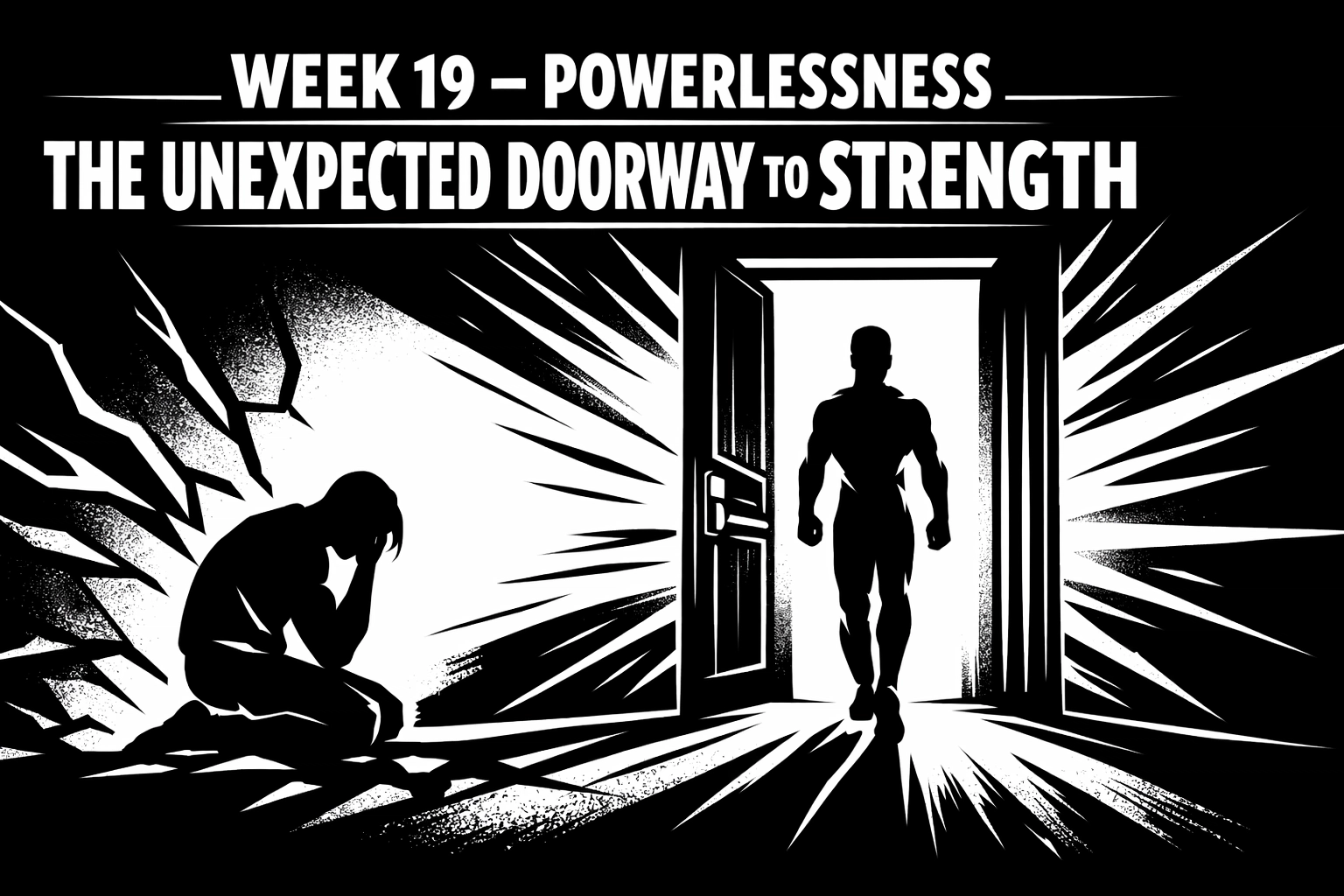
Week 19 – Powerlessness: The Unexpected Doorway to Strength
Dates: February 1–7, 2026
Big Book Reference: Pages 30–31
Focus: Admitting powerlessness opens the door to strength
The Word Nobody Wants to Hear
Let's be honest: the word "powerless" feels like failure. It sounds like weakness, defeat, shame. In active addiction, the idea of being powerless made most of us furious. We told ourselves, "I can stop whenever I want", even when our lives kept proving otherwise.
Step One asks us to admit we are powerless over alcohol (or our drug of choice) and that our lives have become unmanageable. For people who have spent years trying to control everything, how much we use, what people see, what we feel, what we remember, this feels like the ultimate surrender.
But here's the twist: admitting powerlessness isn't about beating ourselves up. It's about finally telling the truth. I have lost control over this. My life has become unmanageable. My way is not working.
That honesty isn't defeat. It's the doorway to a different kind of strength.
The Illusion of Control (And What It Really Costs)
Before admitting powerlessness, most of us tried hard to control our addiction. We made rules: only on weekends, only this amount, never alone, never before work. We convinced ourselves that this time would be different if we were just stronger, smarter, more disciplined.
But here's the pattern we all know: every rule eventually got broken. The lines moved. The boundaries blurred. Control, the thing we thought would keep us safe, was an illusion all along.
The Big Book reminds us that the idea we're like other people and can drink or use normally has been fatal. Self-will and self-control were slowly killing us, no matter how hard we tried to manage it.
Trying to control the uncontrollable cost us:
- Peace of mind
- Restful sleep
- Relationships and trust
- Money and stability
- Self-respect
Even when we "managed" for a little while, it always slipped through our fingers again. The exhaustion of pretending we had it together was just as destructive as the substance itself.
Today's honest question: What has your attempt to control cost you? Not to shame yourself, but to see clearly. Because when we see what control has really done, surrender stops feeling like punishment and starts looking like freedom.
Powerless Doesn't Mean Hopeless
Here's the critical distinction that changes everything: powerless does not mean hopeless.
Step One says we're powerless over alcohol or our addiction, that our lives have become unmanageable. It does not say we are powerless over every part of our lives, or that nothing can ever change. It says: On my own, with this thing, I am beaten.
That sounds heavy. But it's actually where hope sneaks in.
Because if I can't do it alone… maybe I don't have to. Maybe a Higher Power, a fellowship, a program can do what I couldn't do by myself.
Try this reframing: instead of "I'm powerless, I'm doomed," say, "I'm powerless alone, but I'm not alone anymore." Feel the difference? Powerlessness is a doorway, not a dead end.
Research on powerlessness in recovery confirms this: admitting powerlessness redirects your effort toward what you can control, rather than exhausting yourself trying to change what you cannot. When you acknowledge powerlessness over the effects of addiction, you empower yourself to take control over the decisions and actions within your power, like the choice not to use or to seek help.
You are not hopeless. The fact that you're reading this, thinking about this, means hope is already at work in your life.
The Relief Nobody Talks About
Here's something we don't discuss enough: admitting powerlessness can bring relief.
For so long, many of us carried the weight of fixing ourselves, hiding our problem, managing our use, holding our lives together with duct tape and denial. When we finally said, "I can't do this anymore. I am powerless over this," a strange thing happened: the weight started to lift.
Surrender felt terrifying and freeing at the same time. We didn't know what came next, but we knew we didn't have to keep pretending we were in control. We could let others in. We could let a Higher Power in.
If you're exhausted from trying to manage the unmanageable, maybe it's time to whisper, "I surrender. I can't do this alone." You don't have to have a perfect Step Three yet. A tired Step One is enough.
There is real rest in finally putting down what was never yours to carry alone.
Powerlessness and a Higher Power
Step One says we're powerless. Step Two and beyond begin to show us: but we are not abandoned.
Admitting powerlessness creates space for a Higher Power, however you understand that, to move. As long as we insist "I've got this," there isn't much room for grace. When we say "I don't got this," we become open to help.
You don't have to have your concept of a Higher Power all figured out today. You don't have to feel super spiritual. You can start with something as simple as: "Whatever is loving, good, and stronger than my addiction, please help me. I am powerless, but I am willing."
Pair your admission of powerlessness with a small act of trust: a prayer, a moment of quiet, a step toward a meeting, a call for help. Powerlessness alone is despair. Powerlessness with a Higher Power becomes the beginning of hope.
Living Step One Daily
Step One isn't something we admit once and move past: it's a truth we live, one day at a time.
Every day, we get to remember: I am powerless over my addiction if I pick it back up. My life becomes unmanageable when I run the show alone. That awareness doesn't shame us anymore: it anchors us. It reminds us to stay close to our program, our people, and our Higher Power.
Living Step One daily might look like:
- Being honest when cravings show up
- Avoiding the people, places, and things that wake up the obsession
- Calling someone before, not after, the spiral
- Admitting quickly when your thinking goes back to "I've got this"
Try saying this simple Step One reminder: "Just for today, I remember I am powerless over this addiction: and I choose not to test that truth." Then lean into the tools that keep you safe.

Wearing Your Truth
At MAP to Victori, we believe recovery reminders shouldn't just live in meetings: they should travel with you. Our Face Everything And Rise hoodie and Not Alone t-shirt serve as daily anchors to the truths that keep us alive.
When you wear "Not Alone," you're not just making a fashion statement: you're carrying a physical reminder that powerlessness doesn't mean isolation. When you see "Face Everything And Rise" in the mirror, you're acknowledging that admitting powerlessness is the bravest thing you can do.
These aren't just shirts. They're wearable Step One reminders for the days when your brain tries to convince you that you've got it under control again.
Your Challenge This Week
Powerlessness, lived honestly, becomes a daily guide that keeps us alive and growing. This week, we invite you to practice radical honesty with yourself.
Complete this sentence: "I am powerless over ______, and my life becomes unmanageable when I try to control it by myself."
Write it down. Say it out loud. Share it in a meeting if you're ready. You don't have to fix it all today. Just tell the truth. That's where real recovery begins.
Powerlessness isn't a dead end. It's the moment we stop lying to ourselves and let help in. It's the moment self-will finally exhausts itself and makes room for something bigger, stronger, and more loving than we ever managed alone.
Just for today, remember: you are powerless over your addiction: and you don't need to test that truth. Lean into the tools, the people, and the Higher Power that keep you safe.
That's not weakness. That's wisdom in action.