

Week 15 – Progress Over Perfection
It's early January, and that familiar voice is probably getting louder in your head. You know the one: it sounds all spiritual and motivated on the surface, but underneath it's demanding and impossible to please. "If you really worked the program, you'd never feel this way." "You should be further along by now." "Real recovery means you don't struggle anymore."
Welcome to perfectionism wearing a recovery mask.
I've fallen for that voice more times than I can count, turning my recovery into some kind of grading system instead of what it actually is: a grace system. And every time I "fail" those impossible standards I've set for myself, the same old demons show up: shame, isolation, and that dangerous thought of "Why bother trying?"
But here's what the Big Book teaches us on page 60, and what I wish someone had told me earlier: "We are not saints. We claim spiritual progress rather than spiritual perfection."
Progress means I don't have to be where I think I should be. I just have to be willing to take the next right step from where I actually am.
When Perfectionism Hijacks Recovery
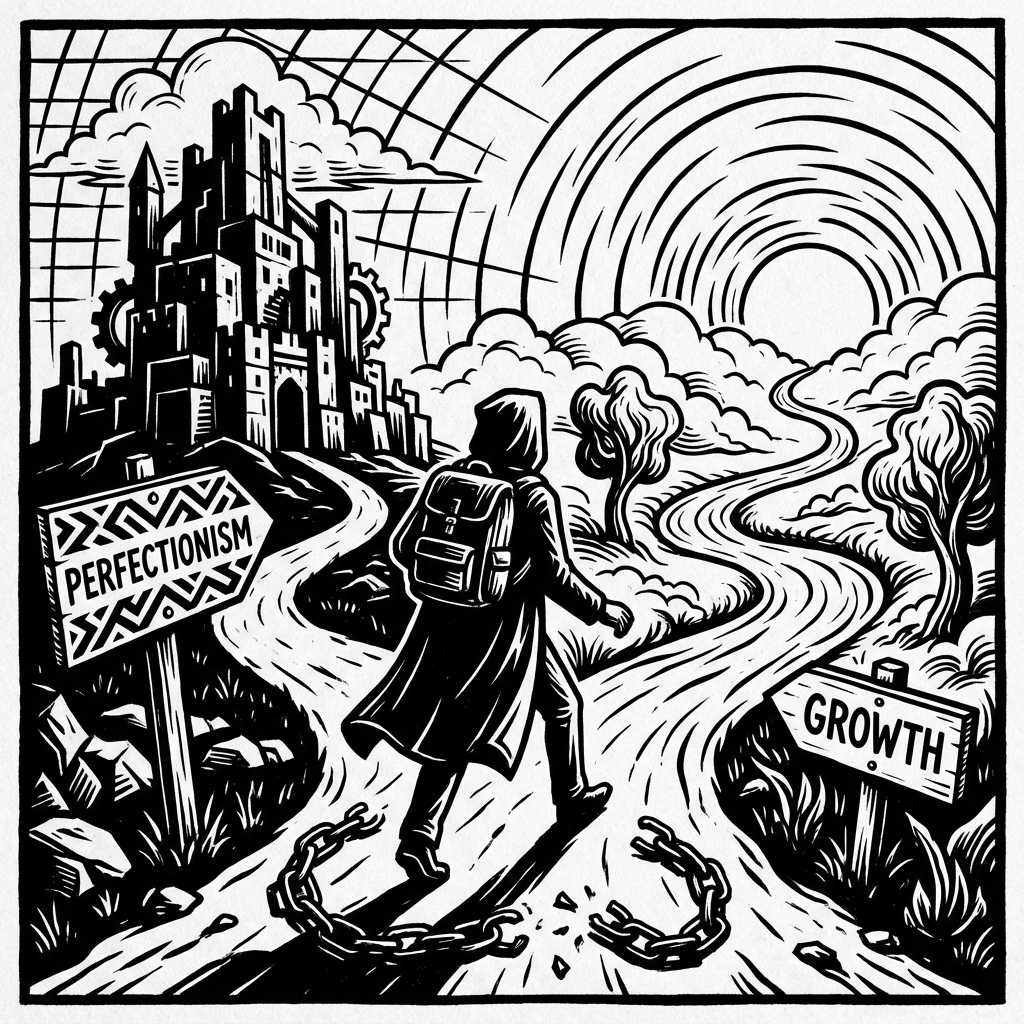
Perfectionism is sneaky in recovery because it disguises itself as dedication. It whispers that anything less than perfect attendance, perfect emotional regulation, or perfect spiritual connection means you're not really working the program.
I've watched it happen to myself and others countless times. Someone misses a meeting and immediately spirals into "See? I'm failing at recovery." Someone snaps at their sponsor and decides they're not spiritual enough yet. Someone has a bad day and throws away weeks of progress because it doesn't fit their idea of what recovery "should" look like.
The problem with this thinking is that it turns recovery into performance instead of process. When I measure myself by perfection, I always come up short. But when I start measuring by progress, something beautiful happens: I begin to see the actual miracles that have been happening all along.
Progress can look like reaching out instead of isolating, even when your brain is screaming to hide. It's pausing before you react, telling the truth a little sooner than you used to, or showing up to a meeting when you didn't want to go. None of that looks flashy on social media, but in recovery terms, those are monumental wins.
All-or-nothing thinking loves to partner with perfectionism. "If I can't do it perfectly, why do it at all?" or "One bad day means I've ruined everything." I've had days where I missed my prayer time, snapped at someone I love, or skipped a call with my sponsor, and immediately my brain said, "See? You're failing at recovery."
But here's the truth that perfectionism doesn't want you to know: one messy day does not erase all the days you showed up. One mistake doesn't cancel out your progress. In this program, we learn to start again: sometimes in the middle of the same day.
How to Interrupt the Perfection Trap
The first step to breaking free from perfectionism is simply noticing where it's trying to hijack your recovery. Is it in how you share at meetings? How you work with a sponsee? How you measure your spiritual growth? You don't have to fix it all at once: just start by naming it.
Instead of asking "Am I perfect yet?" try asking "Am I a little more honest, a little more willing, a little more connected than I used to be?" That shift in question changes everything. It moves you from judgment to curiosity, from shame to self-compassion.
One practice that's helped me immensely is rewriting how I measure growth. Take a moment and write down three ways you've changed for the better in the last six months: emotionally, spiritually, or just in your daily habits. They might seem small, but let yourself actually see your progress. You've worked for it.
Maybe you've gotten better at setting boundaries without exploding. Maybe you're reaching out for help sooner than you used to. Maybe you're actually sleeping through the night more often, or you've stopped checking your phone first thing in the morning. These aren't "small" wins: they're life-changing.
Here's another key insight: perfectionism doesn't just affect how we see ourselves: we often aim it at other people too. We expect family, friends, sponsors, and fellowship members to show up exactly how we think they should. And when they don't, resentment builds.
The hard truth I've had to face is that other people are in process, just like me. They have good days and bad days. They forget, they react, they get stuck in fear: just like I do. Progress over perfection applies to them too. The question becomes: am I willing to allow others the same grace and growth curve I'm desperately begging for myself?
Celebrating Progress and Course-Correcting

In active addiction, a "win" might have meant something extreme: big money, dramatic highs, chaos that felt like living. In recovery, the wins often look quieter, but they're actually revolutionary.
Things like telling the truth when it was uncomfortable. Making your bed and taking a shower when depression felt like a weight on your chest. Not picking up when your brain screamed for an escape. We dishonor our journey when we call those things "no big deal." They are a massive deal.
When shame tries to tell you "You'll never change" or "This is just who you are," remember that your actions matter, but they're not the final word on who you are. Progress means you can respond differently today than you did yesterday. Even if you repeat an old behavior, you can shorten the time it takes to get honest, to apologize, to course-correct.
If shame is loud right now, try this simple practice: put your hand over your heart and say, "I am not my worst moment. I am in recovery, and I am growing." It might feel awkward at first, but sometimes our nervous system needs to hear a kinder voice: especially from ourselves.
When all-or-nothing thinking kicks in, pause and ask: "What is one tiny course correction I can make right now?" Maybe it's a quick prayer, a text to someone in recovery, or simply choosing not to beat yourself up for the next five minutes. We don't throw away the whole journey because of one stumble. We get up, and we keep walking: together.
The Reset: Honoring Where You Are
As you think about this message of progress over perfection, I want you to really take in how far you've come. Think about the version of you who first walked into recovery: or who first admitted that something had to change. What would they say if they could see you now?
Not the imaginary perfect version of you, but the real, still-learning, still-showing-up you who's reading this right now. They'd probably be amazed. You've stayed on or returned to the path when it would have been easier to disappear. You've learned new tools instead of only numbing out. You've shown up for yourself and others in ways you couldn't before.
Today, try writing a short note from your past self to your present self: "Thank you for..." Let them thank you for the progress you keep minimizing. Thank you for not giving up. Thank you for getting back up. Thank you for being willing to try again.
We don't do this journey perfectly. We do it honestly, one day at a time. And that is more than enough.
Recovery isn't about getting an A+ on some cosmic report card. It's about staying honest, connected, and willing. That's real progress. That's real victory.
Your Progress Challenge: This week, notice where perfectionism is trying to hijack your recovery. Instead of aiming for perfect, aim for honest. Share one "small" win with someone in your recovery circle. Write down three ways you've grown in the past six months.
Remember: you're not trying to prove anything to anyone. You're simply showing up as you are, willing to take the next right step. That's progress. That's enough.
Looking for a daily reminder that progress beats perfection every time? Check out our collection of recovery-focused apparel at MAP to Victori: because sometimes we all need a gentle reminder that we're exactly where we need to be in our journey.